

1. Where and Why Are Teens Using Chat Rooms in 2025?
In 2025, chat rooms have evolved into virtual havens where teenagers look for deeper connections beyond mere likes and followers. What matters most to them is finding connections without judgment. While traditional social platforms become louder and more performative, today’s youth are increasingly gravitating toward smaller, more anonymous digital spaces such as niche chat apps, Discord servers, subreddits, and AI companions. According to ACT for Youth, 96% of teens use the internet daily, with nearly half stating they are online «almost constantly.» These spaces provide relief from constant visibility—a place to vent, explore their identities, and ask challenging questions without fear of social consequences. (Source: Youth Statistics: Internet and Social Media)
A report from the Los Angeles Times highlights a growing trend of teens confiding in AI chatbots about their darkest thoughts, including anxiety, loneliness, and suicidal ideation. Meanwhile, a feature from WANE reveals that some teens now turn to AI for advice, friendship, and even as a way to escape their thoughts. This shift reflects how digital tools are filling emotional gaps that once were filled by human relationships. Whether for emotional safety, anonymity, or pure accessibility, the modern chat room has become a lifeline—not just for talking, but for being heard. (Source: Teens are spilling dark thoughts to AI chatbots. Who’s to blame when something goes wrong? Teens say they are turning to AI for advice, friendship and ‘to get out of thinking.)



2. Are Teen Chat Rooms Safe?
It’s a question every parent has typed into Google and every teen, at some point, has ignored: Are chat rooms safe? The reality in 2025 is a complicated mix of evolving technological safeguards and persistent online risks. While some platforms now offer real-time moderation and AI-driven content filters, others remain digital wildlands where anonymity often shelters predatory behaviour.
According to the Cyberbullying Research Centre, nearly 1 in 4 teens reported being bullied online in the past month—a number that rises sharply among LGBTQ+ and transgender youth. A 2022 Pew Research Centre study echoes this, finding that 46% of U.S. teens have experienced at least one form of cyberbullying, including name-calling, rumour-spreading, or receiving explicit images they didn’t ask for. Meanwhile, ACT for Youth reports that 67% of adolescents lose sleep due to excessive digital engagement, and 61% admit to sometimes or often neglecting their daily responsibilities because of the time spent online.
Beyond bullying, chat rooms—especially unmoderated ones—have long been linked to catfishing, grooming, and exposure to sexual content. The Sutter Health network cautions that these online environments can often allow strangers to pose as teens, leading to dangerous interactions and long-term psychological effects. The anonymity that offers emotional refuge can just as easily cloak manipulation.
So, what does safety look like today? It’s not about banning digital interaction but more about vetting it. Reputable teen platforms now include verified profiles, moderation teams, and community guidelines tailored to the needs of adolescents. However, the best safety net still lies in digital literacy: teens need to learn how to spot red flags, and parents need to understand the platforms their kids are using. In short, safety is no longer about control; it’s about informed trust.
3. Our Review Criteria: What Matters in a Chat App
Entering the first half of 2025, chat apps have evolved beyond simple communication tools; for teens, they serve as emotional lifelines, social hubs, and even sources of identity formation. However, not all platforms are designed with adolescent users in mind. That’s why our evaluation framework prioritises five critical dimensions: safety, moderation, privacy, accessibility, and developmental relevance.
First, we assess whether a platform uses active human or AI content moderation, which is essential in an era when 46% of teens report being «online almost constantly» (Pew Research Centre, 2023). We also examine whether the app enforces age-appropriate design, as recommended by the American Academy of Paediatrics (AAP), to minimise risks like inappropriate contact or exposure to harmful content. With cyberbullying affecting about 23% of U.S. teens monthly (Cyberbullying Research Centre, 2023), platforms must provide real-time reporting tools, user-controlled blocking, and transparent community guidelines.
We also pay close attention to the level of control teens have over their digital environments. Can they choose who can message them? Are data collection practices clearly explained and easy to understand? Research from Common Sense Media reveals that while teens value autonomy, they often feel overwhelmed by complex terms and intrusive algorithms.
In summary, we’re not just asking whether a chat app is trendy; we’re asking whether it respects, protects, and empowers young people in a world where their online presence is intricately linked to their real-life well-being.

4. Top Teen Chat Rooms to Try Right Now
In 2025, chat platforms designed for teens are evolving beyond simple communication tools; they are becoming essential digital spaces for forming identities, creating emotional connections, and building communities. With 95% of teens owning a smartphone and 96% going online daily (source: ACT for Youth), many utilise these apps to share their thoughts, explore friendships, and seek emotional support. However, not all platforms are created equal—there are significant differences in safety policies, moderation quality, age-appropriate features, and overall community atmosphere.
Here are some of the most trusted teen chat platforms making an impact this year:
1. BeFriend
- Best For: 17+ teens looking for emotional support & meaningful conversations
- Pros: AI-assisted mood check-ins, anonymous support rooms, clear anti-bullying stance
- Cons: Smaller user base compared to mainstream apps
- Why Try It: Backed by youth mental health advocates, BeFriend blends digital safety with genuine empathy.
- 👉 Join Now!
2. Yubo
- Best For: 16–19-year-olds who enjoy livestreaming and interest-based chats
- Pros: Livestream interaction, swipe-to-connect, verified age checks
- Cons: Risk of inappropriate content without strict filters
- Why Try It: With 60M users globally, Yubo is the Snapchat-meets-Twitch of Gen Z social discovery.
- 🔗 View App
3. LMK (Let Me Know)
- Best For: Teens who want to chat instantly via Snapchat integration
- Pros: Instant connection via stickers, anonymous Q&A format
- Cons: Limited moderation tools, no standalone app
- Why Try It: LMK is casual, quick, and widely used among younger Snapchat users.
- 🔗 Check it Out
4. Spotafriend
- Best For: Older teens (17–19) looking for new friends in their area
- Pros: Swipe-to-match system, profile verification
- Cons: Often mistaken for a dating app
- Why Try It: Geolocation makes it easier to meet teens nearby with similar interests.
- 🔗 Download Spotafriend
5. Wizz
- Best For: Teens who enjoy casual chats with a fun, Gen Z aesthetic
- Pros: Custom avatars, fun icebreakers, quick-connect features
- Cons: Some reports of spam and limited human moderation
- Why Try It: Wizz is energetic and playful — a digital hangout for teens wanting chill vibes.
- 🔗 Explore Wiz
💡 Important Reminder: Always check privacy settings, block/report options, and age verification policies before using any chat platform. Read more about safe online behaviour for teens and cyberbullying statistics to stay informed.
5. Safety Tips When Chatting Online as a Teen
Teen chat rooms may appear friendlier than ever, featuring sleek interfaces, fun emojis, and instant responses. However, beneath the surface often lies a darker reality. The internet remains a hunting ground for predators, exploiters, and cyberbullies who target youth intentionally. According to the Cyberbullying Research Centre, over 51% of teens have been cyberbullied, and 23% report being bullied online within just the past 30 days. Additionally, research from Thorn in 2023 indicates that 1 in 3 teens have been contacted online by someone who made them feel uncomfortable, with many experiencing this before the age of 15.
Excessive sharing is not only hazardous; it can also pose serious risks. A casual mention of your school, a photo in your uniform, or even your pet’s name can be exploited by strangers to manipulate or threaten you. These are not just stories; they represent real cases that law enforcement, trauma centres, and non-governmental organisations deal with every day. According to ACT for Youth, the combination of anonymity and broad reach makes online spaces particularly volatile for developing adolescents who are still forming their identities and boundaries.
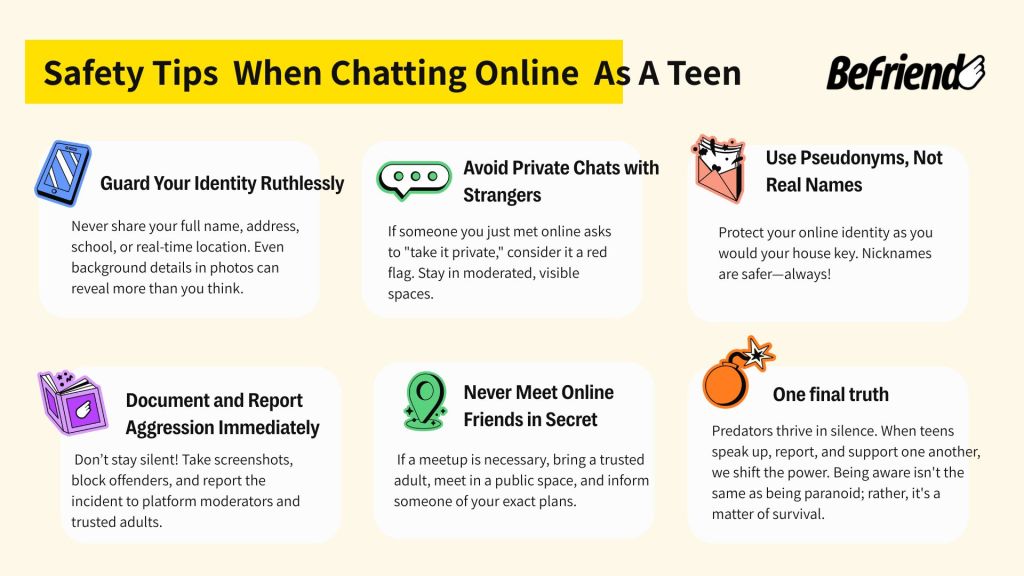
So here comes the most critical question: How can we better protect ourselves? Here are five urgent, non-negotiable safety practices for every teen and parent navigating online chats:
1. Guard Your Identity Ruthlessly: Never share your full name, address, school, or real-time location. Even background details in photos can reveal more than you think.
2. Avoid Private Chats with Strangers: If someone you just met online asks to «take it private,» consider it a red flag. Stay in moderated, visible spaces.
3. Use Pseudonyms, Not Real Names: Protect your online identity as you would your house key. Nicknames are safer—always.
4. Document and Report Aggression Immediately: Don’t stay silent. Take screenshots, block offenders, and report the incident to platform moderators and trusted adults.
5. Never Meet Online Friends in Secret: If a meetup is necessary, bring a trusted adult, meet in a public space, and inform someone of your exact plans.
One final truth: predators thrive in silence. When teens speak up, report, and support one another, we shift the power. Being aware isn’t the same as being paranoid; instead, it’s a matter of survival.
6. Final Thoughts: Choose What Works for You
In a society where young people are increasingly connected online, selecting the appropriate chat room is not merely a choice, but also crucial for safety. Behind every screen lies a story of vulnerability, identity searching, and the need to be heard. However, not all online spaces provide that support. Nearly half of U.S. teens experience cyberbullying, and one in four faces persistent online harassment. Therefore, choosing where teens engage online has become a matter of mental health, not just convenience (Pew Research Centre, 2022).
One of the most dangerous misconceptions we can pass on to young people is that connection is always beneficial. It isn’t—especially if it lacks safety, support, and respect. Unregulated online spaces do not provide freedom; they expose individuals to risks. That’s why trusted organisations like Sutter Health and ACT for Youth recommend environments that prioritise moderation, user autonomy, and education over trends and virality.
Choose wisely. Opt for platforms that value people over popularity. Select those that not only connect you but also protect you—because ultimately, your voice matters most when it’s safe to use. For more insight, visit the Cyberbullying Research Centre and explore evidence-based strategies for fostering healthy online relationships.

Ready to connect?
A space for real friendships —no pressure, no pretending.