

Disclaimer
Article Outline
Introduction
Yubo has gained immense popularity among Gen-Z as a social discovery platform, boasting over 80 million users across 140 countries. The company is actively working to enhance safety by implementing 100% age verification and estimation to deter harmful behaviours. However, for many individuals aged 17 and older, along with their families, the pressing concern often shifts from “Is it popular?” to “Is it safe for me?”
Independent reviewers frequently advise caution for younger teens regarding Yubo, and regulators are increasingly advocating for age-assurance measures as fundamental requirements for social platforms. With research indicating that minors often encounter pressures to share inappropriate content or take conversations to private channels, the landscape is clearly evolving. There’s a growing demand for apps that prioritise verified ages, proactive moderation, and stricter controls on direct messaging.
In light of these concerns, this guide aims to provide a compassionate overview of safer alternatives for users aged 17 and above. It outlines the age verification rules and processes of various apps, explains how moderation mechanisms operate, and highlights privacy controls that empower users to control who can contact them. Your safety and well-being matter, and finding the right platform should reflect that priority.



TL;DR – Quick Picks by Need (17+ Edition)

So, if you’re in a hurry and want a sneak peek at the best alternatives out there, here’s a quick rundown of our top picks for safety and fun. We’ve done the homework, so you don’t have to! Check out these standout apps for 2025 that strike a perfect balance between social discovery and safety checks. Each app on this list has been vetted for age gating, verification, and moderation, ensuring a safer experience for everyone.
1. Best Overall for Safety (17+): BeFriend
– If you’re looking for a reliable companion app, look no further than BeFriend! This app is specifically designed for users aged 17 and above, incorporating robust identity checks and a thoughtful moderation framework that’s built into its design. You can connect confidently, knowing that safety is top-notch!
2. Best for Group Chat: Wizz
– Got a lot to say and enjoy chatting in groups? Wizz has got your back! With room-based topics moderated by both AI and human overseers, it fosters a community atmosphere. Plus, Wizz doesn’t slack on safety—expect profile verification that ensures the person behind the screen is legit. Not just another chatroom; it’s a smart one! Check it out at wizzapp.com.
3. Best for Minimal Interaction / Privacy-Focused: Hoop
– For those who prefer keeping things low-key, Hoop is the answer! Say goodbye to in-app direct messaging anxiety; instead, it connects users to Snapchat after matching. This way, you can focus on cool connections without the risk of unwanted DMs in the app. Stay connected while maintaining your privacy—it’s a win-win!
4. Best interest-based matching: Spotafriend
– This app uses swiping and interest tags so you can find people who actually share your hobbies, rather than random matches. Spotafriend is free to use, although it also offers paid upgrades with additional swipe features.
5. Best free-core option: Wink / Spotafriend / Wizz
– Many of these social apps let you use core discovery features for free, and only charge for enhanced filters, boosts, or premium visibility. For example, Spotafriend offers a free version, with paid “Ultimate Access” upgrades.
Why Matters
Online interactions are increasingly scrutinised, and Yubo has stepped up its game by implementing full age verification measures to enhance safety. Utilising cutting-edge technology, such as Yoti’s facial age-estimation system, users must present a selfie and a “liveness” video, ensuring they are who they claim to be. As social platforms face growing legal pressure to verify user ages and block exploitative interactions, it’s encouraging to see the emergence of apps that emphasise user well-being. These picks provide the new baseline for what “safe social discovery” should look like in 2025, a space where you can connect, share, and grow without the worries that often accompany online interactions.

Yubo vs BeFriend: What Really Sets Them Apart (for 17+ users)
The current social app landscape reveals that features alone are insufficient; what truly shapes a positive user experience is trust, clarity, and careful boundary controls. For instance, Yubo has taken steps to create a safer environment by implementing a real-time selfie and short video check through Yoti’s age-estimation system. This innovative approach enables age verification without requiring formal identification documents, making it more accessible to users. To further protect their community, they utilise a combination of AI and human moderation to monitor livestream chats, ensuring that any violations are addressed promptly.
Similarly, Wizz has recognised the importance of safety by implementing mandatory age verification during registration. They use Yoti’s biometric checks in conjunction with a thoughtful blend of AI and human moderation to monitor interactions, including text and imagery, ensuring a respectful environment for all users.
In contrast to these efforts, BeFriend is emerging as a platform dedicated to creating a genuinely safe and intentional space for those aged 17 and older. Instead of simply adding features to appeal to a younger audience, BeFriend establishes a strict age requirement and employs multi-step verification processes that prioritise user safety. They also offer segment-based group chats, as well as one-on-one direct messaging, along with a comprehensive safety framework that includes 24/7 moderation, opt-in direct messaging, and detailed privacy controls. By integrating a sense of maturity from the very beginning, BeFriend demonstrates that safety isn’t just an afterthought but is foundational to the way we socialise.
Why Red Flags Matter—Especially in 17+ Social Apps
In the fast-paced world of online dating, it’s completely natural to feel excited about connecting with someone new. However, it’s essential to be aware of certain red flags that can serve as an early warning system. Many experts emphasise that a common sign of potential trouble is when someone insists on moving the conversation off the app too quickly, like suggesting, “Let’s switch to Snap or IG.” This can sometimes be a way to dodge the app’s safety measures or to obscure their true identity.
Other warning signs to watch out for include a reluctance to verify their identity or engage in a video call, a preference for chatting only off the platform, or pressuring you for personal information before a foundation of trust is established. These behaviours are consistently highlighted in dating safety guides as things to be cautious about.
Additionally, studies on romance fraud highlight how some scammers rush emotional connections (« love-bombing ») and skip important boundaries to manipulate their matches before any concerns arise. If you ever feel like your match is pushing you to move too fast, avoiding verification, or nudging you beyond your comfort zone, especially before you’ve even met. Trust your instincts. It’s perfectly okay to take a step back, reassess the situation, or even block someone if needed. Remember, your safety and comfort should always be your top priority. This section provides a helpful checklist to identify these signals early on. In any case, take care of yourself first!
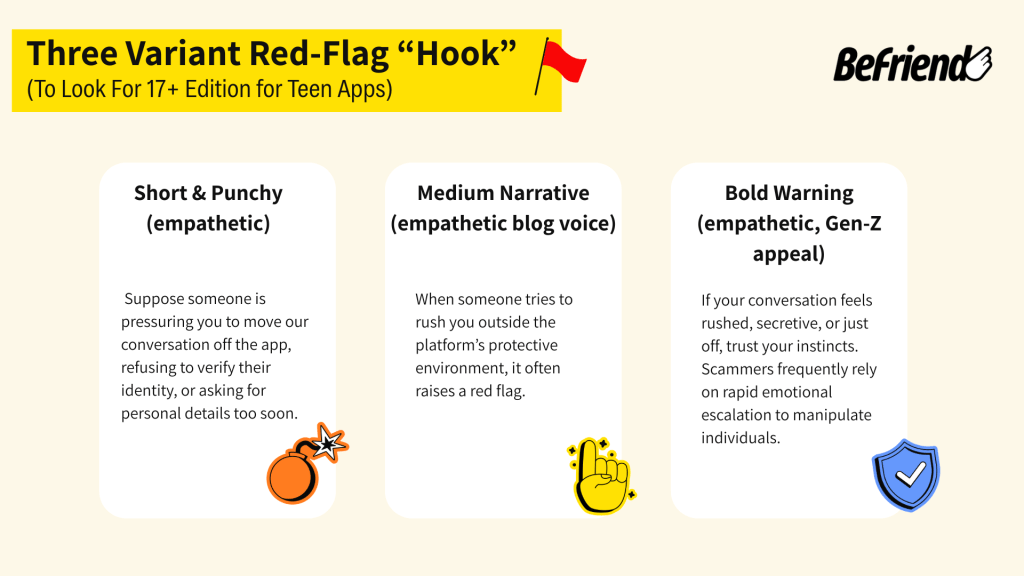
Three Variant Red-Flag “Hooks” to Look For
Short & Punchy (empathetic)
Red flags can feel daunting, but they’re here to protect you. Suppose someone is pressuring you to move our conversation off the app, refusing to verify their identity, or asking for personal details too soon. In that case, it’s completely okay to take a step back. These behaviours are warning signs that your safety may be at risk, and recognising them can help you safeguard your well-being.
Medium Narrative (empathetic blog voice)
Every social app comes with its own challenges, but one crucial truth remains: when someone tries to rush you outside the platform’s protective environment, it often raises a red flag. Trusted online-safety advisors highlight common tactics, such as urging users to switch to Snapchat or Instagram to evade moderation, refusing to verify through a selfie or video, or asking for personal information too quickly. It’s understandable to feel confused or pressured in these situations, but being aware of these signs ahead of time can help you navigate your interactions more safely and confidently.
Bold Warning (empathetic, Gen-Z appeal)
If your conversation feels rushed, secretive, or just off, trust your instincts. Moving discussions off the app too quickly, avoiding verification, or asking for pictures right away are not signs of genuine interest—they’re often indicators that something might be wrong. You deserve to feel safe and respected. Research indicates that scammers frequently rely on rapid emotional escalation to manipulate individuals. Recognise these patterns early, feel empowered to block or disengage, and know that prioritising your safety is always the right choice.
Our Final Thoughts
We understand that making connections online should be a positive and uplifting experience, especially as users reach the age of 17 and beyond. At this stage, it’s completely natural to expect social apps to prioritise trust and safety. Many platforms are actively working to enhance their safety features to meet these expectations. For example, Yubo has introduced complete age verification using Yoti’s facial age estimation system to help ensure that users are in the right age group. However, we recognise that retrofitting safety measures can often be more challenging than implementing them from the beginning.
As the volume of content continues to surge, with billions of posts, images, and messages each day, platforms face the critical task of balancing automated moderation with thoughtful human oversight. This balance is crucial to reducing errors and maintaining a healthy community atmosphere.
It’s in this context that BeFriend is stepping in with a clear purpose. For those aged 17 and above seeking social discovery, we believe the real value lies in an infrastructure designed with intention—one that includes adequate age verification, multi-step verification, tailored moderation paths for different types of interactions (such as group chats versus direct messages), and privacy-first defaults.
While we appreciate that every app highlighted here offers something unique and valuable, our true aim is to support you in making safer, smarter choices, alongside enjoying meaningful connections.
We encourage you to try out various apps and explore the features that matter most to you, always with an emphasis on your safety. The ideal social app should not only allow you to connect with others but also foster a sense of security in those connections. We sincerely hope BeFriend can be part of your journey in this exploration.

Ready to connect?
A space for real friendships —no pressure, no pretending.


