

The Story
- 1. Introduction: Why Everyone’s Talking About “Apps Like Yubo” in 2025
- 2. What is Yubo, and Why Has It Got So Popular
- 3. Why Users Are Looking for Alternatives to Yubo
- 4. Best Apps Like Yubo for Making Friends in 2025
- 5. How to Choose the Right Friendship App for You
- 6. The Future of Gen-Z Friendship Apps in 2025
- 7. FAQ: Apps Like Yubo, Safety, and Making Friends Online
1. Introduction: Why Everyone’s Talking About “Apps Like Yubo” in 2025
Gen Z is truly transforming the social discovery landscape in 2025. They are seeking more than just entertainment; they desire safe, real-time environments where they can connect with new individuals and cultivate a sense of belonging in an often overwhelming digital landscape. Yubo stands at the forefront of this movement, acting as a live social discovery app that prioritises safety through verified age checks and various safety tools. With the recent launch of a comprehensive age-verification program in collaboration with Yoti, Yubo aims to create a secure environment that limits interactions between different age groups and reduces the risk of fake accounts. (Yubo, Social live-streaming platform Yubo implements an industry-leading age verification system)
As teens continue to spend more time online, reports from reputable sources, including Pew, show that many U.S. teens are online “almost constantly.” (Source: NP New, Nearly half of US teens are online ‘constantly,’ Pew report finds)This highlights the growing need for platforms that prioritise safety and foster genuine friendships rather than romantic connections. Yubo has cultivated a vibrant community of over 60 million users globally, and independent case studies reveal strong positive sentiments about its safety features. This strong emphasis on security is why so many young people are searching for „apps like Yubo,” seeking the best options for meaningful, friendship-focused experiences. (Source: Teck UK, AI Adoption Case Study: Learn how Yubo pioneered 100% user age estimation to drive safety and trust among Gen Z)



2. What is Yubo, and Why Has It Got So Popular
Yubo, initially launched in France in 2015 by a group of passionate engineering students, Sacha Lazimi, Jérémie Aouate, and Arthur Patora, was born from a genuine desire to create a welcoming space for young people to forge meaningful connections in real time. Unlike traditional social media that often encourages passive scrolling, Yubo, named initially “Yellow,” allows users to engage in lively group live stream chats with up to 10 people, while unlimited viewers can join in. (Source: Internet Matters, What is Yubo? What parents need to know)
It introduced an innovative swipe-based discovery feature tied to interest tags, aiming to provide Gen Z with an experience that blends casual hanging out with global social exploration. (Source: eSafety Commissioner, What is YUBO?)
At the heart of Yubo’s success is its unwavering focus on the needs and preferences of Gen Z, with around 95-99% of its users belonging to this dynamic age group. This attention to their unique culture and behaviours has shaped the app’s features in a way that resonates deeply with its audience. Furthermore, Yubo’s commitment to safety and identity verification shows a commendable understanding of the challenges young users face. Partnering with Yoti, Yubo has implemented advanced facial age-estimation technology, ensuring that 100% of users are verified, while creating age-gated communities to better protect teens from adult interactions. (Source: Yoti, How Yubo pioneered 100% user age estimation to drive safety and trust among Gen Z; TechCrunch, Gen Z social app Yubo rolls out age ‘estimating’ technology to better identify minors using its service)
However, Yubo’s inspiring journey is not without its challenges. Its engaging mechanics, such as swipes and live rooms, can sometimes echo those of dating apps, leading to understandable concerns from parents and regulators regarding whether the platform truly fosters friendship or if it blurs the lines into flirtation. (Source: ParaentZone UK, What parents need to know about Yubo) As the user base continues to grow, reportedly exceeding 60 million active users across more than 140 countries by 2023-24, Yubo faces the ongoing challenge of scaling social safety effectively.
In essence, Yubo exemplifies a remarkable case study in aligning innovative products with the values of a generation at just the right moment. It has embraced livestreaming, community tagging, and identity protections, responding to Gen Z’s desire for authentic and low-pressure online social experiences. Yet, the obstacles it encounters reflect a broader need among users for “apps like Yubo” that not only promise connection but also prioritise safety and a friendship-first approach.
3. Why Users Are Looking for Alternatives to Yubo
Many users, especially those in Gen Z, have been feeling a sense of disconnect with Yubo despite its widespread popularity. They yearn for something more profound, meaningful relationships built on trust rather than casual flirtation. The platform’s current setup, which includes features such as live streaming, swiping, and large broadcast rooms, unfortunately, creates some confusion. Users often find it challenging to differentiate between making friends and dating, leaving them uncertain about their experiences.
A recent study from 2025 highlighted that nearly one in four teens is using apps that were initially intended for adult social or romantic interactions. (Source: EurekAlert! Teens are using dating apps more than you’d think. It may not be a bad thing; Source: New Study Finds Teens Exploring Digital Romance — With or Without Safe Spaces) This shift suggests that younger users often perceive themselves as navigating the complexities of dating rather than simply forming friendships. Although Yubo has invested in safety tools, like age estimation technology and community moderation, many young users still express valid concerns about their online safety. Alarmingly, nearly half perceive the digital space as “unsafe or hostile.” This has sparked a strong desire for platforms that prioritise moderation and empower users with greater control. (Source: Social Discovery Insights: Yubo User Poll Reveals Gen Z Views On Online Safety; INEQUE, Virtual Friendships, Why Do Young People Make Friends Online?)
Moreover, as conversations around equity and identity continue to evolve, there’s an increasing call for apps that promote inclusivity and focus on shared interests, rather than adult-centred interactions. Young people deeply value authentic connections and seek out communities where the goal is clear: to make friends, not dates. While Yubo has undoubtedly set a foundation, the next generation is looking for platforms that not only promise friendship but also foster a sense of safety and trust. This has led many to explore alternatives that resonate better with their vision of forming genuine friendships online.
4. Best Apps Like Yubo for Making Friends in 2025
If you are searching for the same “meet new people now” energy that made Yubo popular, but want more apparent friendship intent and stronger safety signals, these platforms are the ones Gen Z actually uses. The picks below strike a balance between real-time discovery and product features that help nudge interactions toward platonic connections.
BeFriend
BeFriend positions itself as a friendship-first social app, with copy in its App Store listing that explicitly frames the product around making friends and combating loneliness in a safe, inclusive environment. This clarity of purpose is why it resonates with users who want “friends, not dates.”
Wizz
Wizz focuses on rapid discovery across a global audience, utilising swipe discovery and instant chat to help teens connect with people when they are online. That breadth is a draw, but parents and reviewers have flagged moderation gaps, so teens and guardians should review settings and usage expectations before diving in. (Wizz App: Chat Now; Wizz App – chat now)
Yubo
Yubo remains a central hub for live rooms and swipe-to-add features, and it has rolled out age-verification measures with Yoti, designed to gate interactions by age group. If you enjoy real-time interaction with new people, Yubo still delivers that core experience, alongside its documented safety investments. (Yubo: Chat Meet & Make Friends; Yubo: Make friends & chat now)
Snapchat friend discovery features
Snapchat is not a dedicated friend-finding app, yet many teens use its built-in discovery features to expand their social circle. Snapchat’s “Find Friends” and Public Profile features help users be discoverable and connect beyond existing contacts, which can complement a friendship-first app in your stack. (Snapchat: What features come with a Public Profile on Snapchat?)
Discord communities
If you prefer interest-based spaces over swiping, Discord’s server directory makes it easy to join communities built around hobbies, games, art and local scenes. Joining a few well-moderated servers is a reliable way to turn shared interests into real friendships. (Discord: DISCOVER YOUR NEXT FAVORITE SERVER)
4.1 BeFriend — The Friendship-First Social App
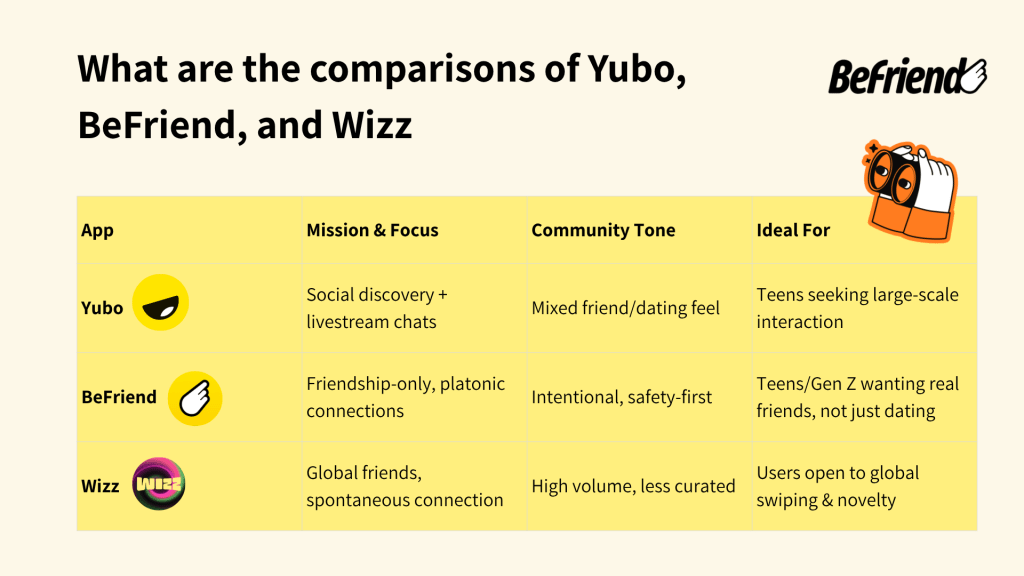
Here is a quick comparison of mission, tone and suitability:
| App | Mission & Focus | Community Tone | Ideal For |
| Yubo | Social discovery + livestream chats | Mixed friend/dating feel | Teens seeking large-scale interaction |
| BeFriend | Friendship-only, platonic connections | Intentional, safety-first | Teens/Gen Z wanting real friends, not dating |
| Wizz | Global friends, spontaneous connection | High volume, less curated | Users open to global swiping & novelty |
By narrowing your focus to apps like BeFriend and Wizz, you align more precisely with the genuine “friend-make” segment, leaving behind the dating-adjacent vibes that many users now want to avoid.

5. How to Choose the Right Friendship App for You
When choosing a platform for connection, it’s essential to consider what feels right for you, particularly in terms of protecting your privacy and aligning with your daily habits. Start by considering your intentions: if you’re seeking friendships, look for an app that openly promotes itself for platonic connections. Make sure its community guidelines support that vision. With teens and young adults spending more time online than ever, the design choices of these platforms can significantly shape their experiences.
Next, take a closer look at the safety measures in place. It’s essential to find platforms that not only promise safety but also actively work to create a secure environment. Look for features like identity or age verification, effective moderation, and straightforward options to block or report users. A transparent help centre or family tools that clearly outline how to supervise settings and control content can be valuable resources. (GLANCE: What Safety Features Should My Dating App Have To Protect Users?)
Additionally, it’s vital to prioritise your privacy just as much as you do the app’s features. (Source: Internet Matters, Social Media platforms guide; Safety on social media. ) Verify that the platform allows you to limit who can view your profile, manage location sharing, and adjust data permissions. Consider using trusted resources to enhance your device’s privacy settings before establishing connections. (Source: Common Sense Media: What Are the Best Privacy Settings for My Kid’s Apps and Devices?)
Lastly, it’s crucial to ensure that the product respects youth data protection laws and provides clear pathways for addressing any concerns about data misuse. In the U.S., there are specific obligations regarding services used by children and teens, and regulators are increasingly attentive to how social platforms handle these matters. Your safety and well-being matter, so take the time to make informed choices. (Source: Crowell, Online Privacy and Safety: The FTC Weighs in on Surveillance, Privacy, and Safeguards)
6. The Future of Gen-Z Friendship Apps in 2025
Friendship apps designed for Gen-Z are evolving to create safer, more meaningful social spaces, guided by three critical trends that reflect the needs and hopes of young people today. First, the level of engagement is remarkably high, with many teens feeling a strong desire for constant connection. Almost half of U.S. teens are online almost constantly, with platforms like YouTube and TikTok deeply integrated into their daily lives. This opens the door for products that encourage low-pressure interactions focused on friendship, allowing young people to connect in ways that feel genuine and supportive. (Source: Pew Research Centre, Teens, Social Media and Technology 2023)
Second, there’s a growing demand for safety and well-being, pushing developers to create experiences that prioritise secure and age-appropriate interactions. Concerns about the risks of social media are very real, as highlighted by the U.S. Surgeon General, who emphasises the need for protective measures in online spaces. Additionally, regulations like the U.K.’s Online Safety Act are establishing essential safeguards, and leading apps are now implementing robust age verification processes to ensure a secure environment for youth.
Finally, community design is evolving, moving from a model of one-way communication to one that fosters a sense of belonging. Young people increasingly seek online spaces where they can feel closer to their friends and maintain meaningful relationships. This shift encourages features like interest-based matching, supportive group chats, and moderated communities, which are far more enriching than just swiping through profiles.
As a result, we see a future filled with smaller, welcoming spaces that prioritise thoughtful safety measures, stronger privacy protections, and a clear sense of purpose. (Source: Data.ai, STATE OF
MOBILE 2024, The Industry’s Leading Report)These innovations aim to help Gen Z discover genuine friendships, rather than merely accumulating followers. In this changing landscape, the focus is on quality, compassionate connections that truly enhance their lives.
Frequently Asked Questions
What apps are like Yubo but not for dating?
BeFriend, Wizz, and Patook are friendship-only apps designed for genuine connections instead of dating. They use ID verification and moderation to keep communities safe.
Is Yubo still safe to use in 2025?
Yubo partners with Yoti for facial-age verification and moderation. It is safer than before, but users should still manage privacy settings and avoid sharing private info.
What is the best friendship app for Gen-Z?
BeFriend is one of the top Gen-Z friendship apps with verified profiles, safety tools, and interest-based matching to help users meet real friends online.
How can I find real friends online safely?
Use platforms with clear safety rules, reporting tools, and verified users. BeFriend and moderated Discord groups are trusted spaces for safe friend-making.
What makes BeFriend different from Yubo or Wizz?
BeFriend focuses on friendship only, while Yubo and Wizz mix dating and social discovery. Its algorithm connects users by hobbies and mutual interests.
Are teen chat rooms safe in 2025?
Modern chat rooms include AI moderation and ID verification. Apps like BeFriend and Yubo separate age groups to create a safer environment for teens.
Can I make friends on apps without revealing my real name?
Yes, many apps allow nicknames and anonymous profiles. Always check privacy controls to manage who can see your personal details.
Which friendship apps work best internationally?
BeFriend, Yubo, and Wizz have global user communities. Discord and Snapchat also connect users across regions through shared interests.
Why are people leaving Yubo for other apps?
Users are turning to smaller, safer spaces with clearer intentions. Friendship-focused apps like BeFriend attract users who prefer genuine conversation over follower counts.
How do I know if a friendship app is legit?
Check App Store reviews and whether the platform collaborates with third-party safety partners such as Yoti or Thorn. Legit apps publish privacy and transparency reports.

Ready to connect?
A space for real friendships —no pressure, no pretending.


