The Story
- 1. From MSN Messenger to Micro-Communities — The Evolution of Teen Chat
- 2. Why Teens Prefer Private, Interest-Based Spaces
- 3. What’s Driving Teen Chat in 2025
- 4. The Role of Safety in Shaping Teen Chat Behaviour
- 5. Trends We Can’t Afford to Ignore
- 6. Where Teen Chat Is Heading Next
- 7. Brand Readiness Checklist: Capturing the Next Wave of Teen Chat
- 8. Our Final Thoughts: Teen Chat Culture Is Key for Staying Relevant



From MSN Messenger to Micro-Communities — The Evolution of Teen Chat
In the late 1990s, platforms like AIM and MSN Messenger became popular. These included features like buddy lists, pixelated avatars, and fun away messages. Socialising was open and spontaneous, with messages coming from anyone, allowing for unexpected connections. However, everything changed with the arrival of smartphones in the late 2000s and the rise of social apps in the 2010s.
By 2024, 95% of teens had smartphones, and nearly half of teens say they are online almost constantly, up from 24% a decade ago. (Source: Teens, Social Media and Technology 2024)This change shifted communication from large public chatrooms to smaller, interest-focused groups. Now, platforms like Discord and WhatsApp, along with various niche apps, enhance privacy, use AI for moderation, and curate tailored content. This appeals to Gen Z and Gen Alpha, who want safe spaces for connection and meaningful interactions.
Even Meta has leaned into this shift: in early 2024, the company turned off the ability for teens to receive DMs from strangers by default, ensuring messages can only come from people they follow or are connected to, a move that signals the growing importance of small-group interaction over anonymous reach in youth social behaviours. In 2025, the teen chat experience focuses on belonging to a close-knit community where meaningful connections can grow. (Source: Introducing Stricter Message Settings for Teens on Instagram and Facebook)

Why Teens Prefer Private, Interest-Based Spaces
We are seeing teens migrate from the noisy town square to smaller “living rooms” for a reason: control, relevance, and safety. With 96% of U.S. teens online daily and the share who are online “almost constantly” roughly doubling since 2014–15, the social feed has become ambient background noise—so teens gravitate to private, interest‑based micro‑communities where identity can be curated. Risks are easier to manage (Source: Paw Research Centre, Teens, Social Media and Technology 2024). Platforms are codifying this shift: Meta’s Teen Accounts default to private settings and now layer on stricter DM context and messaging limits for minors, reducing unwanted contact and nudging conversations into trusted circles (Source: Expanding Teen Account Protections and Child Safety Features) Meanwhile, real‑world enforcement underscores why teens value gated spaces: Discord’s latest enforcement filings show tens of thousands of accounts disabled for harassment in a single period, highlighting the demand for moderated, topic‑specific servers over open broadcasts. Regulators see the same dynamics: reports widespread underage/age‑misstated profiles and more frequent age‑verification prompts—pressure that further steers youth engagement into smaller, safer groups with clearer guardrails.
What’s Driving Teen Chat in 2025
As we move into 2025, the world of teen chat is changing in exciting ways that brands need to notice! Niche social apps are becoming very popular, with savvy investors backing platforms that focus on real interests rather than just trying to reach a large audience. This shift is driven by Gen Z and Gen Alpha, who value real connections over fleeting fame, as noted by Business Insider. (Source: Dating, loneliness, AI: 12 investors explain where they’re placing their bets in consumer tech)
At the same time, safety has become a top priority—AI-assisted moderation is now essential for chat platforms. For instance, Roblox has introduced the open-sourced Sentinel system, which helps detect grooming and predatory behaviour in billions of messages. In early 2025, it alerted law enforcement about over 1,200 cases, setting a new standard in the industry, according to AP News. (Source: Roblox rolls out open-source AI system to protect kids from predators in chats)
Moreover, the boundary between online and offline interactions is fading. Teens are not just chatting; they are studying together, working on projects, and even meeting up in person within lively micro-communities. These activities are now central to how teens interact online.
Overall, these exciting trends are transforming teen chat into something much more meaningful. It has become a crucial way for teens to connect, providing a private, safe, and authentic experience.
The Role of Safety in Shaping Teen Chat Behaviour
Safety has transitioned from merely being a checklist requirement to a crucial aspect of teen chat in 2025. Platforms are changing from reacting to issues to actively protecting teen digital spaces. Snapchat has introduced “Safeguards for Teens” that automatically turn on privacy settings, limit friend requests, and make it easier to report bad behaviour. This helps promote connections between friends rather than strangers. Parents can also track their teens’ interactions through the Family Centre, which allows them to see who their teens talk to and, when turned on, access live location updates. This encourages conversations rather than spying. (Source: Snapchat, Safeguards for Teens)
Meta has also improved its Teen Accounts in 2025. Now, account privacy is the default setting, safety prompts appear in direct messages, and unknown contacts are restricted. This change focuses on trust instead of just reaching more people. Similarly, Discord, which has been seen as chaotic, is evolving. Its new Safety Hub now blurs direct messages by default, includes age restrictions for channels, and adds proactive moderation to server design. Teens want a place where they can express themselves safely. (Source: Discord’s Commitment to Teen and Child Safety)
Today’s under-18 users want both freedom and safe spaces. Safety has become a key way to engage them. For brands wanting to connect with Gen Z and Gen Alpha in real ways, being part of these trusted environments is essential.

Trends We Can’t Afford to Ignore
The teen chat environment in 2025 is changing. Teens are moving away from public spaces and looking for smaller, private groups where they feel they belong. Recent research shows that almost half of U.S. teens are online “almost constantly,” but they prefer private groups where they control who sees their posts (Source: Pew Research Centre, Teens, Social Media and Technology 2024)
This trend is driving changes in major social media platforms. For example, Snapchat has introduced “Safeguards for Teens” that focus on friend-only sharing and engaging based on context (Source: Snapchat, Safeguards for Teens). Similarly, Meta has adjusted its Teen Accounts to be private by default and reduce unwanted contact (Source: Expanding Teen Account Protections and Child Safety Features).
For brands, this means they need to shift their marketing strategies. Instead of focusing on reaching a broad audience, they should aim for meaningful participation in communities. We can see good examples of this with Nike hosting sneaker drops on Discord to create exclusivity and LEGO offering moderated online hangouts where teens can share their builds and ideas in safe, interest-focused spaces.
In the current landscape, it is evident that success extends beyond merely achieving high view counts. It involves engaging in meaningful conversations and establishing genuine connections with audiences, while maintaining a balanced approach that avoids excessive promotional tactics.
Where Teen Chat Is Heading Next
The next frontier in teen chat combines immersive worlds, AI companionship, and purpose-driven micro‑communities—forming the architecture of Generation Z’s digital social life. Research from Gartner forecasts that 25% of people will spend at least one hour daily in the metaverse by 2026, spotlighting an imminent shift from static chat feeds to dynamic social environments blending education, identity, and entertainment. (Source: Gartner Predicts 25% of People Will Spend At Least One Hour Per Day in the Metaverse by 2026) Already, platforms like Roblox and Fortnite are evolving into virtual “third places,” hosting immersive events—from concerts to collaborative hangouts—that go well beyond text-based chat. (Source: Fortnite, Minecraft, and Roblox are creating virtual worlds – here’s how marketers can engage)
Over the next two to three years, expect teen chat to evolve into immersive, AI-augmented social hubs, where real-time safety, personalisation, and shared experience converge. Brands that experiment early in these hybrid spaces—offering value rather than intrusion—stand to become authentic fixtures in the next generation’s digital lives.
Brand Readiness Checklist: Capturing the Next Wave of Teen Chat
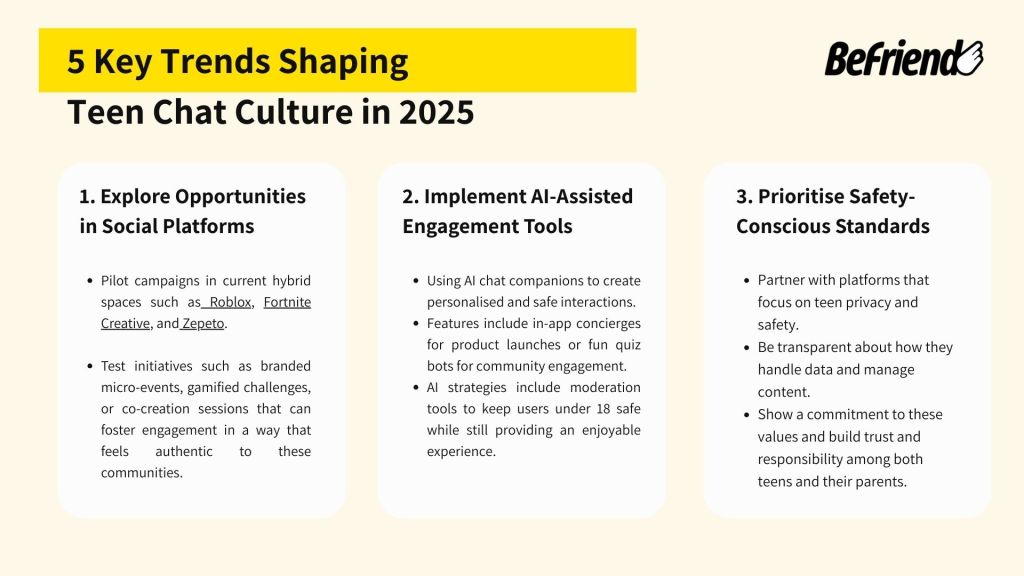
1. Explore Opportunities in Social Platforms
Rather than waiting for the full emergence of the metaverse, brands should consider piloting campaigns in current hybrid spaces such as Roblox, Fortnite Creative, and Zepeto. Testing initiatives such as branded micro-events, gamified challenges, or co-creation sessions can foster engagement in a way that feels authentic to these communities.
2. Implement AI-Assisted Engagement Tools
Utilising AI-driven chat companions can help brands scale personalised and safe interactions. This can include features such as in-app concierges for product launches or gamified quiz bots designed for community engagement. Any AI strategy must incorporate moderation tools to ensure the safety of audiences under 18, while still maintaining an enjoyable experience.
3. Prioritise Safety-Conscious Standards
Aligning with platforms that prioritise teen privacy and safety, such as Snapchat’s Family Centre and Meta’s Teen Accounts, is essential. Users should be transparent about their data handling and content moderation practices. Demonstrating a commitment to these values can enhance trust and accountability among both teens and their parents.
Our Final Thoughts: Teen Chat Culture Is Key for Staying Relevant
Teen communication in 2025 has evolved into a fundamental aspect of the social landscape for Gen Z and Gen Alpha, significantly influencing their identity formation, friendship dynamics, and brand affiliations. The platforms where our subsequent generations engage—ranging from private Discord servers to friend-only Snapchat groups and interest-based networks like BeFriend—are emerging as vital social spaces.
What is particularly noteworthy is the shifting expectation among teens for safe, relevant, and values-driven environments. They demonstrate a clear preference for brands that honour these expectations. As digital platforms increasingly emphasise privacy-first and safety-oriented features, marketers have a unique opportunity to engage in these conversations—not as disruptors, but as authentic participants offering real value.
For businesses that are prepared to listen, adapt, and engage in a manner that resonates with teens, the potential rewards extend beyond mere visibility; they encompass lasting relevance in the everyday digital experiences of the upcoming generation. The best teen chat spaces now combine fun, shared interests, and strong community safeguards, giving you the freedom to connect without worry. If you’re ready to find new friends and join conversations that matter, explore safe teen chat platforms like BeFriend, where every interaction starts with trust and ends with connection.
Ready to connect?
A space for real friendships — no pressure, no pretending.


Ready to connect?
A space for real friendships —no pressure, no pretending.