Self-Care Guide for Gen Z
- 1. Introduction
- 2. Understand What Your Anxiety Is Trying to Protect You From
- 3. Limit Exposure to Unrealistic Beauty Standards
- 4. Replace Criticism With “Body-Neutral” Language
- 5. Use Social Media, Don’t Let It Use You (NIH Study)
- 6. Practice Micro-Exposure Instead of Avoidance
- 7. Build a “Reality Check” Ritual for Negative Thoughts
- 8. Sleep as Mental Health Medicine
- 9. Strengthen Social Safety Through “Low-Stakes Connection”
- 10. Our Final Thoughts: Gen Z Deserves Gentler Spaces
Introduction
Gen Z is growing up in a world that never seems to turn off. Every notification, every photo, every story view becomes another moment to compare, evaluate, and worry about how you appear to others. It is no surprise that younger users report the highest levels of anxiety among all generations, with many describing constant pressure to look perfect and to socialise flawlessly both online and offline. According to the APA’s most recent Stress in America reports, young generations are significantly more likely to feel overwhelmed by daily stressors and to say they struggle with appearance-related and social challenges. The digital environment amplifies these feelings because the moment you open an app, you are flooded with polished lives, edited bodies, and highlight reels that can make your own reality feel inadequate. (Source: American Psychological Association, “Stress in America 2023: A Nation Recovering from Collective Trauma; Vox, Gen Z misery, explained in one chart)
Self-care today encompasses much more than just skincare or meditation; it involves learning to protect your mental space within a landscape built on visibility. Controlling your digital habits becomes essential, allowing you to shape your self-perception rather than letting algorithms dictate it. Most importantly, cultivating the confidence to show up as your unfiltered self is crucial, even when anxiety encourages you to retreat.
In this guide, we explore ten research-grounded self-care strategies designed explicitly for Gen Z. These insights are based on real studies, real behavioural patterns in the mobile and social apps industry, and the lived experiences of young people navigating social pressure on a large scale. If anxiety, comparison, or digital overload has been affecting your confidence, this article is your starting point for rebuilding clarity, emotional balance, and a healthier connection.




Understand What Your Anxiety Is Trying to Protect You From
For many in Gen Z, anxiety can feel overwhelming, but it often serves as a protective system that has become hyperactive in our always-online world. The American Psychological Association’s “Stress in America 2023” report highlights that younger adults frequently describe their stress levels as completely overwhelming and struggle to cope in daily life. (Source: American Psychological Association, Stress in America 2023, A nation recovering from collective trauma; Pulse, Gen Z: to live, not to overproduce) When you spend hours scrolling through social media, where performance, productivity, and appearance are constantly on display, it’s natural for your mind to scan for social threats, much like it would for physical dangers.
Experts in public and mental health have pointed out that heavy, emotionally charged social media use correlates with increased rates of anxiety, depression, and self-doubt among young people, especially when screen time surpasses three hours each day. (Source: EMORY, ROLLINS SCHOOL OF PUBLIC HEALTH, Gen Z, Social Media, and Mental Health; The U.S. Surgeon General’s Advisory, Social Media and Youth Mental Health) From the perspective of the mobile and social apps industry, we regularly observe this reflected in behavioural data. Users who feel anxious might tend to lurk instead of posting, rewrite messages multiple times, or withdraw from conversations after making small mistakes.
A compassionate reframe to consider is: “What is my anxiety trying to protect me from in this moment?” Often, the answer may revolve around fears of rejection, humiliation, or losing status in a highly visible digital landscape. Recognising anxiety as a protective signal rather than a personal flaw can empower you to adjust your environment and habits, fostering healthier relationships and online interactions. This mindset shift is a crucial step towards cultivating mental well-being and genuine connections.
Limit Exposure to Unrealistic Beauty Standards
Unrealistic beauty standards are one of the biggest silent drivers of anxiety for young users in image-first apps. Research summarised by Harvard public health experts shows that repeated exposure to highly edited photos and idealised bodies on social platforms is strongly linked to body dissatisfaction and disordered eating in teen girls, who are often the heaviest users of visual apps. (Source: Harvard T.H. Chan School of Public Health, Exploring the effect of social media on teen girls’ mental health)
A 2024 study from the University of Waterloo found that 55 per cent of teens worldwide who use social media report being dissatisfied with their appearance, confirming that negative body image in the algorithm era is a global issue rather than a niche concern. (Source: Study: negative body image among teens is a global issue) Many teens report that the content they encounter online exacerbates their concerns about their appearance. (Source: Ballad Brief, The Link Between Social Media and Body Image Issues Among Youth in the United States) From the perspective of the mobile and social apps industry, it’s evident that feeds prioritising polished “fitspiration” or celebrity-style content push users into a cycle of comparison, intensifying self-criticism and discouraging genuine social participation. By intentionally curating your online experience and limiting exposure to unrealistic standards, you can foster a kinder environment for yourself. Choosing to follow creators who showcase diverse, unfiltered bodies can help reset your internal perception of beauty. This thoughtful approach fosters a healthier body image and conserves your emotional energy for deeper connections, both online and offline, enabling you to cultivate a more authentic self.
Replace Criticism With “Body-Neutral” Language
For many Gen Z individuals, transitioning from feeling “I hate how I look” to “I love my body” can seem entirely unrealistic, especially in a social media landscape that often amplifies our perceived flaws. It’s important to recognise how challenging this can be, and that’s where body-neutral language can serve as a valuable self-care tool. Rather than putting pressure on ourselves to feel beautiful all the time, body neutrality encourages us to connect with our bodies in a more grounded way. It invites us to appreciate what our bodies do for us, rather than constantly measuring them against often unattainable beauty standards.
Mental health resources, such as Verywell Mind, describe body neutrality as a practice of accepting our bodies for their capabilities rather than their appearances. This approach can help lessen negative feelings and provide a protective shield against disordered eating, especially compared to a focus on how we look. (Source: VeryWell Mind, Body Positivity vs. Body Neutrality)The Emily Program, a leading provider of eating disorder treatment, emphasises that body neutrality sees the body as “neither good nor bad,” which allows us to nurture ourselves even on days we struggle with self-acceptance. (Source: The Emily Program, Understanding Body Positivity, Body Acceptance, and Body Neutrality)
Recognising the importance of this mindset, wellness programs at universities like Ohio State University’s Student Wellness Centre are actively teaching students the value of body-neutral language. (Source: U.OSU, Be Well and Thrive Student Life, Student Wellness ) They define it as showing respect towards our bodies without the aim of changing them. HelpGuide, a respected mental health resource, encourages both parents and young people to communicate in body-positive or body-neutral ways, emphasising how the language we use can influence self-image and resilience against body shaming. (Source: HelpGuide, Body Shaming, The Effects and How to Overcome it)
For those who frequently engage with image-driven social media, shifting our inner dialogue from “My stomach looks awful” to “My body helped me get through a long day” can alleviate self-criticism, minimise comparison, and help create a more accepting online environment. It’s all about fostering a kinder relationship with ourselves in a world that can often feel overwhelming. (Source: WIKIPEDIA, Body neutrality)
Use Social Media, Don’t Let It Use You (NIH Study)
In today’s mobile-first social landscape, simply logging onto a platform doesn’t guarantee a meaningful connection. In fact, mindless scrolling can often amplify feelings of anxiety rather than alleviate them. The U.S. Surgeon General’s Advisory on Youth Mental Health highlights a concerning reality: while nearly 95% of teens actively engage with social media, a significant number report using it “almost constantly.” This heavy usage is unfortunately linked to increased risks of anxiety and depression. (Source: EMORY, ROLLINS SCHOOL OF PUBLIC HEALTH, Gen Z, Social Media, and Mental Health; The U.S. Surgeon General’s Advisory, Social Media and Youth Mental Health)
Research published in JAMA Network Open offers some hope, showing that reducing screen time for leisure among children and adolescents can lead to meaningful improvements in emotional well-being, diminishing feelings of sadness and anxiety while fostering more positive interactions with peers. (Source: JAMA Networks, Screen Media Use and Mental Health of Children and Adolescents, A Secondary Analysis of a Randomised Clinical Trial)
In the mobile apps industry, it’s essential to recognise the difference between active participation, such as posting a heartfelt story, sharing an emotional comment, or reaching out to a friend, and passive consumption, like endless scrolling or silent comparisons. This passive mode can intensify social anxiety, making you feel watched and judged, even as you remain invisible.
To nurture a healthier relationship with social media, consider prioritising intentional engagement as a self-care strategy. It can be as simple as sharing a short story, sending a quick message to someone you trust, or engaging in creative activities like art, hobbies, or joining micro-communities. By doing so, you reclaim a sense of agency and connection, rather than succumbing to isolation.
Over time, this shift from being an unconscious observer to an active participant can be incredibly empowering. It can help build your confidence, reduce social anxiety, and transform your digital presence into a supportive aspect of your overall well-being. Remember, every small step you take towards intentional engagement can make a significant difference in how you feel and connect with others.
Practice Micro-Exposure Instead of Avoidance
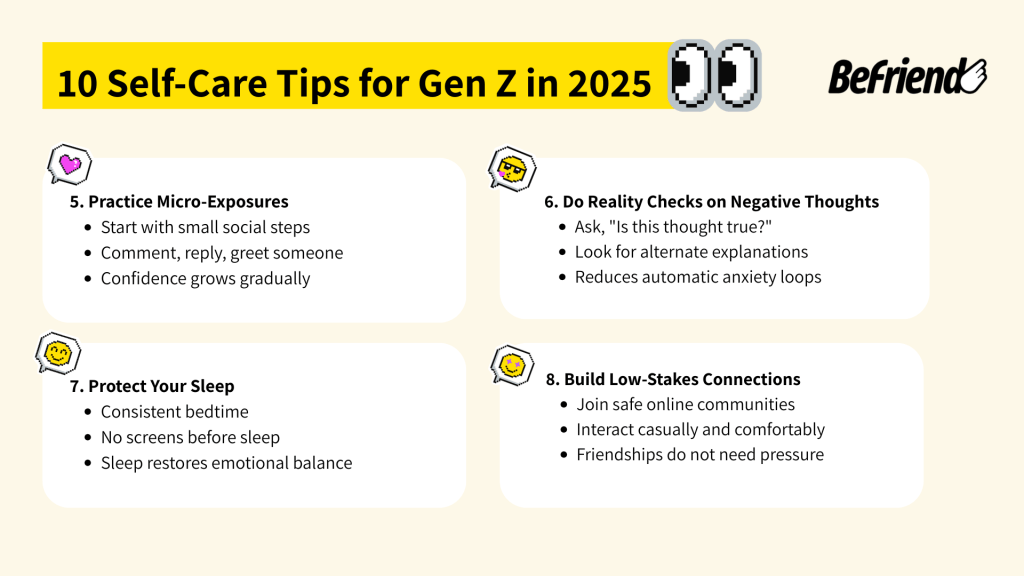
It’s completely understandable to want to avoid uncomfortable social situations. In the short term, they may feel safer, but this avoidance can lead our brains to perceive ordinary social encounters as threatening. Exposure therapy is a well-supported treatment for anxiety that encourages us to face our fears in small, manageable steps. (Source: apa.org, What Is Exposure Therapy?) This gentle process helps our nervous system learn that we can navigate these situations without catastrophe. The American Psychological Association illustrates that exposure encourages us to confront, rather than escape, our fears, gradually reducing anxiety over time. Similarly, many Gen Z users in the mobile and social app world find themselves lurking, deleting posts, or leaving messages unanswered, all driven by the fear of rejection. Micro-exposure can be a powerful form of self-care, allowing you to take baby steps. Consider sending a short message, commenting on a post, or participating in a low-pressure group chat, rather than diving into a large gathering. These small, repeated actions in safe digital spaces help rewire your brain, reinforcing the idea that you can take part without fear. Little by little, these micro-steps can significantly rebuild your social confidence and ease that anxiety. (Source: Determinants of Exposure Therapy Implementation in Clinical Practice for the Treatment of Anxiety, OCD, and PTSD: A Systematic Review-PMC; Cognitive Behavioural Therapy (CBT) What CBT is and How it Helps )
Build a “Reality Check” Ritual for Negative Thoughts
In today’s fast-paced digital world, it’s easy to feel overwhelmed by every notification, read receipt, or viewed story that triggers thoughts like “They are ignoring me” or “I sounded stupid.” These thoughts are often cognitive distortions, which can amplify anxiety and affect our self-esteem. Learning to challenge these automatic negative thoughts is essential for our well-being. (Source: Harvard Health Publishing, How to recognise and tame your cognitive distortions) A simple “reality check” ritual can work wonders when these anxious thoughts arise. When you find yourself spiralling, take a moment to ask three gentle questions: What actual evidence do I have for this thought? What are two alternative explanations? What would I say to a friend feeling this way? For those spending significant time on social apps, this structured self-inquiry helps transform overwhelming feelings into manageable insights. While it may not eliminate stress overnight, it gradually diminishes the hold that self-critical thoughts have on your online behaviour, allowing you to engage more freely and kindly with yourself. (Source: PositivePsychology: Cognitive Distortions: 15 Examples & Worksheets (PDF))
Sleep as Mental Health Medicine
When we’re tired, even the simplest social interactions can feel daunting. The CDC has observed that children and adolescents who don’t get enough sleep face a greater risk of mental health challenges. (Source: Sleep and Health, Physical Education and Physical Activity) A troubling 2023 report indicates that many teens are not meeting their sleep needs, a pattern linked to the broader youth mental health crisis. (Source: Association Between Insufficient Sleep, Depressive Symptoms, and Suicidality Among Florida High School Students) Recognising the importance of sleep as a non-negotiable self-care practice is vital. It might be as simple as setting a fixed log-off time, keeping your phone out of reach overnight, or opting for calming podcasts instead of fast-paced videos in the hour leading up to bed. Prioritising sleep not only combats fatigue but also equips your brain to handle social cues and minor conflicts with greater ease, helping you feel less overwhelmed in everyday interactions.
Strengthen Social Safety Through “Low-Stakes Connection”
Building confidence involves forming deep friendships and cherishing the little moments that affirm our sense of safety among others. Research indicates that brief interactions, even with strangers or acquaintances, can significantly improve our mood and alleviate feelings of isolation. Engaging in small talk, like chatting with a barista or exchanging smiles with a classmate, can uplift our spirits and foster a sense of community. (Source: Psychology Today, How Daily Small Talk Can Improve Well-Being) Articles in psychology highlight how these “micro-interactions” contribute to our happiness, acting as a reminder that we are part of a larger world. Embracing these low-stakes connections can create a tapestry of social reassurance, reminding us that there are caring people around, even in simple encounters. These small, positive exchanges can lay the groundwork for deeper social confidence and shared joy. (Source: Simple micro‑actions can boost psychological well‑being, new research suggests)
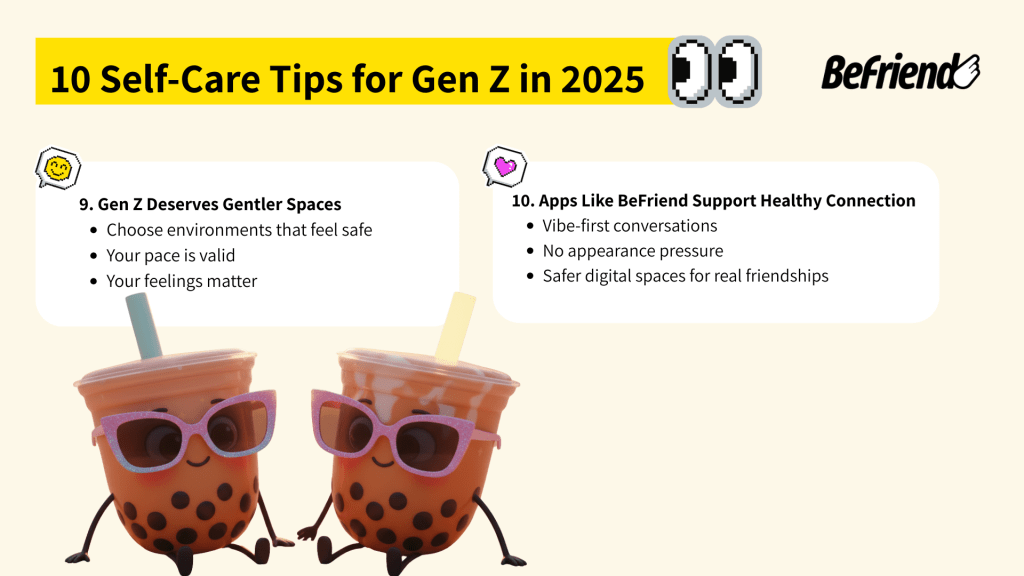
Our Final Thoughts: Gen Z Deserves Gentler Spaces
Gen Z is navigating one of the most digitally intense eras in history, often feeling overwhelmed by social pressure, algorithmic visibility, and comparison on a massive scale. According to a Barna survey, 39% of Gen Z express frequent uncertainty about the future, with many grappling with anxiety around major life decisions. This reveals a profound truth: Gen Z seeks safer, kinder, and more understanding environments, both in physical and digital spaces. (Source: Barna, Gen Z’s Emotional Challenges: A Unique Opportunity for the Church)
As experts in mobile and social apps, we’ve observed that the most successful platforms are those that foster an atmosphere of non-judgment, enable authenticity, and prioritise emotional safety. For self-care to resonate deeply with young people, it must focus on creating social spaces that foster warmth and acceptance rather than a performance-driven atmosphere. By cultivating this nurturing environment, young people can show up as their authentic selves—embracing all their imperfections—within conversations, friendships, and communities. When mental health, self-expression, and social connection become integral components rather than mere afterthoughts, Gen Z can thrive, building emotional resilience and a genuine sense of belonging.
It’s essential to create spaces where you can be the “unfiltered version” of yourself. Your mental health flourishes in environments where you feel safe, seen, and free from judgment. Research from Counselling Today reveals that Gen Z is particularly attuned to peer-emotional challenges, with 70% of teenagers across demographics identifying anxiety or depression as significant concerns among their peers. (Source: American Counselling Association, The emotional and social health needs of Gen Z) Digital youth communities play a vital role in this landscape: a study on Gen Z emotional engagement highlights that “digital entertainment communities are affective ecosystems where emotional expression, connection with peers, and identity experimentation intertwine.” This means that young people often feel more at ease experimenting with their true selves when they connect over shared interests rather than superficial statuses. (Source: Research Gate, Virtual Sociality and Identity Construction: Understanding Gen Z Emotional Engagement in Digital Entertainment Communities)
Apps like BeFriend are changing the game by creating relaxed, vibe-driven environments where young people can engage in open conversations, express themselves authentically, and connect without the pressure of judgment based on looks or social status. By promoting healthy self-care within safe social environments, we believe we can enhance confidence and foster genuine relationships, especially for young generations. Let’s work together to build a world where every young person feels valued and accepted just for being themselves.
Frequently Asked Questions
Why do I feel anxious every time I use social media?
Many Gen Z users experience anxiety online because social feeds are designed around comparison and visibility. Idealized lifestyles and edited images can intensify pressure. Curating your feed and limiting passive scrolling can reduce this stress.
How can I stop comparing myself to others online?
Unfollow accounts that trigger insecurity, increase exposure to authenticity‑focused creators, set daily limits, and replace passive scrolling with hobbies or informative content.
What are quick self-care habits that actually help with anxiety?
Two minutes of deep breathing, morning light exposure, short walks, or a five‑minute digital detox can regulate your nervous system and interrupt anxious spirals.
How can I deal with appearance anxiety?
Adopt body-neutral statements such as “My body helps me move” and avoid heavily edited content. Follow creators who show realistic and diverse looks to reset expectations.
What should I do if social situations make me nervous?
Try micro‑exposures like greeting a cashier or messaging a friend. Small, repeatable interactions help retrain your brain to view socializing as safe.
How do I build social confidence if I’m introverted or shy?
Join low‑pressure, interest‑based communities and practice short but regular interactions. Social confidence grows through repetition, not personality type.
Is online friendship healthier than in-person friendship?
Online friendships can be equally meaningful when based on shared interests and emotional safety. What matters is consistency, trust, and mutual respect.
How can I use social media without letting it affect my mental health?
Mute stressful accounts, turn off unnecessary notifications, and use platforms intentionally. Curate a feed that inspires you instead of draining you.
How can I make new friends if I struggle with social anxiety?
Start with low‑pressure spaces like hobby groups or friendship‑focused apps. These environments provide clearer expectations and reduce social performance pressure.
Can apps like BeFriend actually help me feel less anxious socially?
Yes. BeFriend encourages low‑pressure, vibe‑based conversation and reduces appearance‑driven interactions, which helps young users build confidence safely.

Ready to connect?
A space for real friendships —no pressure, no pretending.